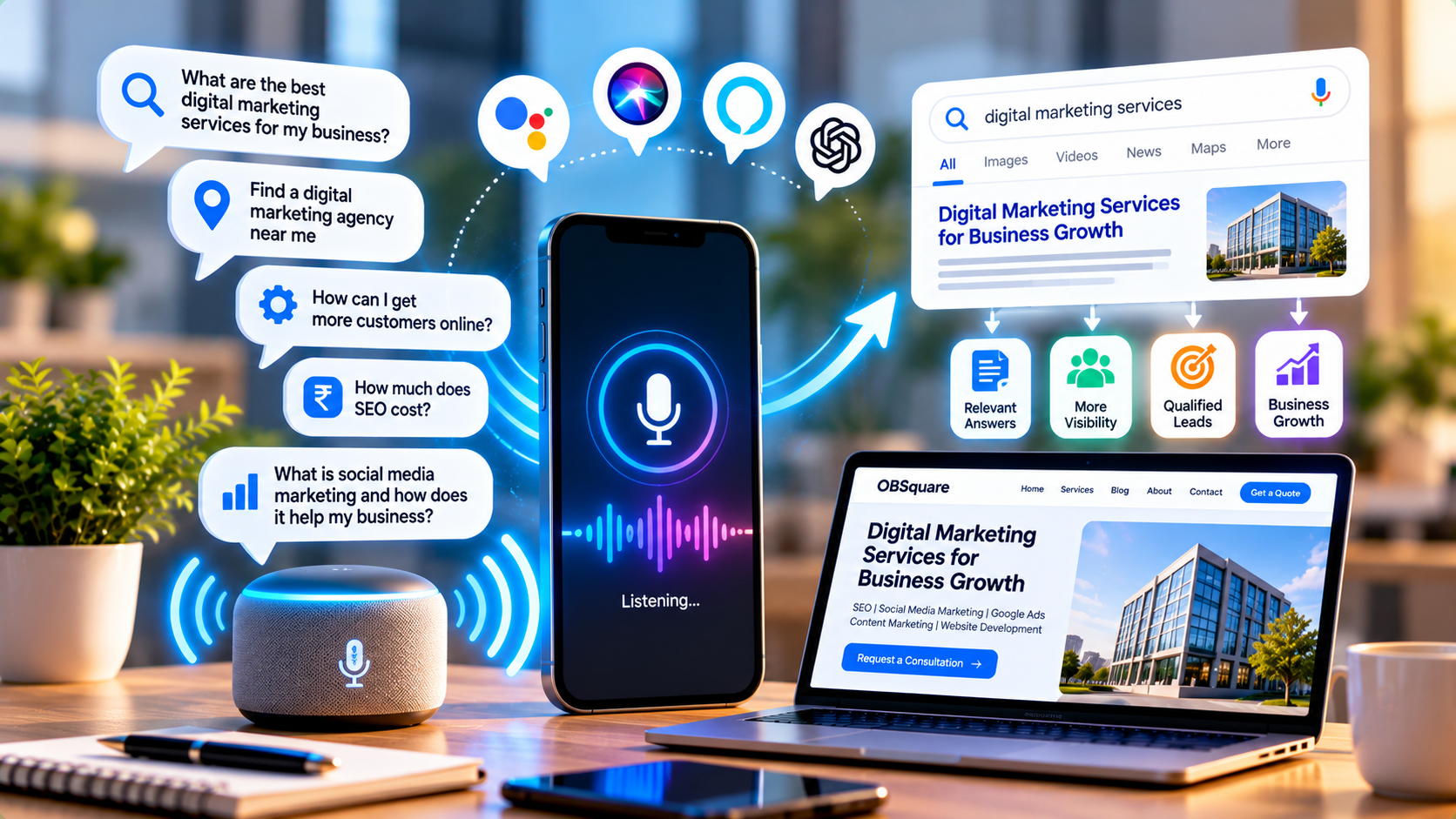
How Can AEO Help Businesses Reach Customers Using Voice and Conversational Search?
Introduction: How Are Voice and Conversational Search Changing Digital Marketing?
People no longer rely exclusively on short keyword searches to find information online. They increasingly use complete questions, voice commands, and conversational prompts to explore topics, compare products, and identify service providers.
A person might type "digital marketing agency Pondicherry" into a search engine. Another might ask a voice assistant, "Which digital marketing services can help my small business get more customers?" A conversational search user might follow up by asking about pricing, expected results, or the services included in a marketing package.
These different search behaviors create opportunities for businesses to provide useful answers at the right stage of the customer journey.
Answer Engine Optimization (AEO) focuses on making content clear, relevant, and useful for answer-oriented search experiences. When combined with SEO, local digital marketing, and high-quality content, AEO can help businesses prepare for how customers discover information across different platforms.
At OBSquare, an effective digital marketing strategy should focus on understanding customer questions and creating content that helps people make informed decisions.
What Is Answer Engine Optimization (AEO)?
Answer Engine Optimization is a digital marketing approach that emphasizes creating and organizing content to answer users' questions clearly.
Traditional SEO helps businesses improve their opportunities to appear in relevant organic search results. AEO complements SEO by paying particular attention to the questions users ask, the information they need, and how clearly a webpage addresses those needs.
For example, a business providing website development services might create content answering questions such as:
- How much does a business website cost?
- What features should a business website include?
- How long does website development take?
- How can a business website generate more enquiries?
These questions can inform blog posts, service pages, FAQs, and educational resources.
AEO does not guarantee that a search engine or voice assistant will select a particular webpage as its answer. Its primary purpose is to help businesses provide clear, useful information that matches customer intent.
Why Are Voice and Conversational Searches Important for Businesses?
Voice and conversational search experiences allow users to ask questions in a natural way. Instead of entering a few keywords, people can describe what they want, explain a problem, or ask follow-up questions.
This behavior is especially relevant when customers need quick information about products, services, locations, opening hours, and purchasing decisions.
Customers Use Natural-Language Questions
A customer researching a marketing service may ask, "How can I improve my business visibility on Google?" rather than searching only for "SEO services."
Businesses that understand these questions can create content addressing the problem behind the query.
Searchers Need Relevant and Clear Information
People often want a straightforward explanation before exploring a service in greater detail.
A clear service page that explains the offering, target audience, process, and next steps can help potential customers understand whether the service meets their needs.
Local Searches Can Lead to Business Actions
Customers may use voice or conversational tools to find nearby services, check business details, or identify providers in a particular area.
Accurate business information, useful location pages, and a well-maintained Google Business Profile can support local discovery across relevant search experiences.
However, voice searches do not always lead to a single spoken answer, and results depend on the platform, query, and available information.
How Can Businesses Identify Questions for Voice Search Optimization?
AEO begins with understanding what customers want to know. Businesses should use real customer questions and search data rather than creating content based on assumptions alone.
1. Review Customer Enquiries
Sales conversations, customer support requests, emails, and contact forms can reveal recurring questions.
For example, a digital marketing agency may discover that customers frequently ask about SEO timelines, advertising budgets, social media packages, and campaign performance.
These questions can become useful content topics.
2. Research Question-Based Search Queries
Keyword research tools and Google Search Console can help businesses discover relevant searches that include phrases such as "how," "what," "where," "when," and "which."
The purpose is not to add every question to the website. Instead, marketers should prioritize questions that are relevant to their services and that they can answer accurately.
3. Study Customer Needs at Different Stages
Questions vary depending on whether someone is learning about a topic, comparing providers, or preparing to purchase.
An introductory question may be best answered in a blog post. A question about service inclusions may belong on a service page, while a question about contact options may be answered directly on a contact or location page.
Matching questions to the appropriate page creates a more useful customer experience.
How Can Businesses Create Content for Voice and Conversational Search?
Content designed for conversational queries should be clear, relevant, and easy to understand. It should answer the user's question while providing enough context to avoid misleading or incomplete information.
1. Provide Direct Answers
Start by answering the main question in a straightforward way, then explain the details.
For example, an article about local SEO could begin by explaining that local SEO helps businesses improve their visibility for relevant searches associated with a location. The following sections can discuss business listings, location information, customer reviews, and relevant website content.
This structure helps readers understand the main point before exploring the supporting information.
2. Use Natural and Descriptive Headings
Headings should clearly communicate what each section covers.
Question-based headings can be useful when they reflect genuine customer questions, but every heading does not need to be written as a question.
The goal is to make the content easy to navigate and understand rather than to force conversational keywords into every section.
3. Explain Complex Topics in Simple Language
Businesses should avoid unnecessary jargon when a simpler explanation will communicate the same idea.
For instance, instead of only discussing "conversion rate optimization," a business could explain how improving forms, calls to action, and page usability may help more visitors complete an enquiry.
Clear explanations can help readers understand the subject regardless of their technical knowledge.
4. Include Relevant Examples
Examples help readers apply information to their own circumstances.
A digital marketing agency could explain how a local retailer might improve its online presence by maintaining accurate business information, publishing useful service content, and making contact options easy to find.
Examples should be realistic and should not imply guaranteed results.
How Can SEO and AEO Work Together?
SEO and AEO have complementary roles in a digital marketing strategy.
SEO supports organic search discoverability, while AEO emphasizes the clarity and usefulness of answers provided by website content.
Optimize Pages for Relevant Search Intent
Businesses should create pages that match the purpose behind customer searches.
Someone researching the basics of digital marketing may need an educational article. Someone searching for professional digital marketing services may need a detailed service page explaining the available offerings.
Improve Internal Linking
Relevant internal links help visitors move from an answer to related information.
For example, an article explaining the benefits of SEO can link to a detailed SEO service page where readers can learn about the actual services offered.
Maintain Technical SEO Quality
Important pages should be accessible to search engines, have appropriate metadata, and use clear website navigation.
Businesses should also ensure that pages load reliably, display correctly on mobile devices, and contain accurate information.
These practices support search accessibility and user experience, but they do not guarantee a featured answer or a particular ranking.
How Can AEO Support Local Business Discovery?
Local businesses can use AEO principles to make important service and location information easier for customers to understand.
Maintain an Accurate Google Business Profile
Businesses should keep their business name, category, address or service area, operating hours, contact details, and website information accurate.
They should review the profile regularly and update details when circumstances change.
Create Useful Location-Specific Content
A business serving Pondicherry, for example, can explain which services it provides in the area and address relevant customer needs.
Location pages should offer meaningful information rather than repeating the same content with only the place name changed.
Answer Questions About Local Services
Potential customers may want to know whether a service is available in their area, how to make an appointment, or how to contact the business.
Clear answers and accurate contact information help people evaluate their options.
Local optimization can support discovery, but it does not guarantee that a business will be selected as a voice response or AI recommendation.
How Can Structured Data Support AEO?
Structured data provides additional context about webpage content using a standardized vocabulary such as Schema.org.
For suitable pages, structured data can describe articles, organizations, products, services, and other entities. This may help supported systems interpret the content more consistently.
Businesses should select schema types that accurately match their pages and ensure that the markup reflects information visible to users.
For example, an article may use Article or BlogPosting structured data, while an appropriate business page may use Organization or a suitable subtype.
Structured data should be validated and maintained as the website changes. It does not guarantee that a page will appear in a featured snippet, voice response, or AI-generated answer.
How Can AEO Improve Digital Marketing Campaigns?
AEO can help businesses make campaign content more relevant by connecting marketing messages to the questions customers ask.
Use Customer Questions in Content Campaigns
Questions collected from customers can inform blogs, social media posts, short videos, email content, and landing-page sections.
For example, an agency could create a blog answering how businesses can generate more leads online, then adapt its key insights into short social media posts.
Each format should be tailored to its audience and platform.
Connect Educational Content to Services
A helpful article can introduce a topic and direct readers to a relevant service page when they want to explore professional assistance.
This creates a natural path from learning about a problem to considering a solution.
Align Content With Campaign Objectives
Businesses should define whether a campaign aims to increase awareness, attract relevant website traffic, generate enquiries, or support customer retention.
Question-focused content should be planned according to these objectives and evaluated using appropriate performance indicators.
How Can Businesses Measure AEO Performance?
AEO performance can be difficult to measure directly because different answer-oriented platforms provide different reporting capabilities.
Businesses can still use a combination of search, engagement, and conversion metrics to evaluate whether their content is supporting the intended goals.
Useful indicators include:
- Search impressions and clicks: Reveal how pages perform for relevant organic queries.
- Performance of question-focused content: Helps identify which articles attract relevant visitors.
- Engagement with related pages: Shows whether readers explore additional resources.
- Enquiry form submissions and calls: Measure meaningful customer actions.
- Qualified leads: Help assess whether content attracts the intended audience.
- Referral traffic from AI platforms: Where identifiable, provides additional information about visits from supported platforms.
Google Search Console and website analytics can support this process. Businesses should avoid assuming that all voice searches or AI interactions can be tracked accurately.
Ultimately, the value of AEO should be considered alongside the quality of the content and its contribution to broader marketing objectives.
Common AEO Mistakes Businesses Should Avoid
Businesses should avoid treating AEO as a shortcut to search visibility.
Creating content only for keywords: Content should address real questions and provide useful information.
Adding unnecessary FAQ sections: FAQs should answer genuine customer concerns rather than repeat existing content.
Using overly complicated language: Clear explanations help readers understand the subject.
Ignoring traditional SEO: AEO should complement technical SEO, accessible pages, and relevant content.
Publishing inaccurate information: Answers should be current, verifiable, and consistent with the services offered.
Expecting guaranteed voice search results: No content format or optimization method guarantees selection by a voice assistant.
Neglecting the customer journey: Useful answers should connect naturally to relevant resources and appropriate next steps.
Avoiding these mistakes helps businesses create content that is useful to people and supports a more consistent digital marketing strategy.
How Can OBSquare Help Businesses With AEO and Digital Marketing?
OBSquare supports businesses with digital marketing services that can help improve online visibility, communicate brand value, and reach relevant audiences.
Depending on business needs, an integrated strategy may include SEO, blog writing, website content optimization, Google Business Profile management, social media marketing, paid advertising, video content, and website development.
For AEO-oriented marketing, businesses can identify recurring customer questions, create useful educational resources, improve the clarity of service pages, and connect related content through relevant internal links.
These activities can complement SEO and GEO as part of a coordinated digital marketing plan.
OBSquare can help businesses plan content around customer needs, maintain consistent messaging across channels, and measure progress using relevant performance indicators. The appropriate strategy depends on the business's services, audience, competition, and objectives.
Conclusion: Prepare Your Content for Conversational Search
Voice and conversational search experiences provide new ways for people to ask questions, discover services, and explore available solutions.
AEO encourages businesses to understand these questions and respond with clear, accurate, useful content. When combined with SEO, local optimization, structured information, and relevant digital marketing campaigns, it can help businesses create a more helpful online presence.
No single technique guarantees selection by a voice assistant or answer engine. Businesses should focus on serving their audiences, maintaining accurate information, and making their websites easy to navigate.
With a coordinated digital marketing strategy, OBSquare can help businesses work toward stronger online visibility, better customer engagement, and more meaningful enquiries across evolving search experiences.