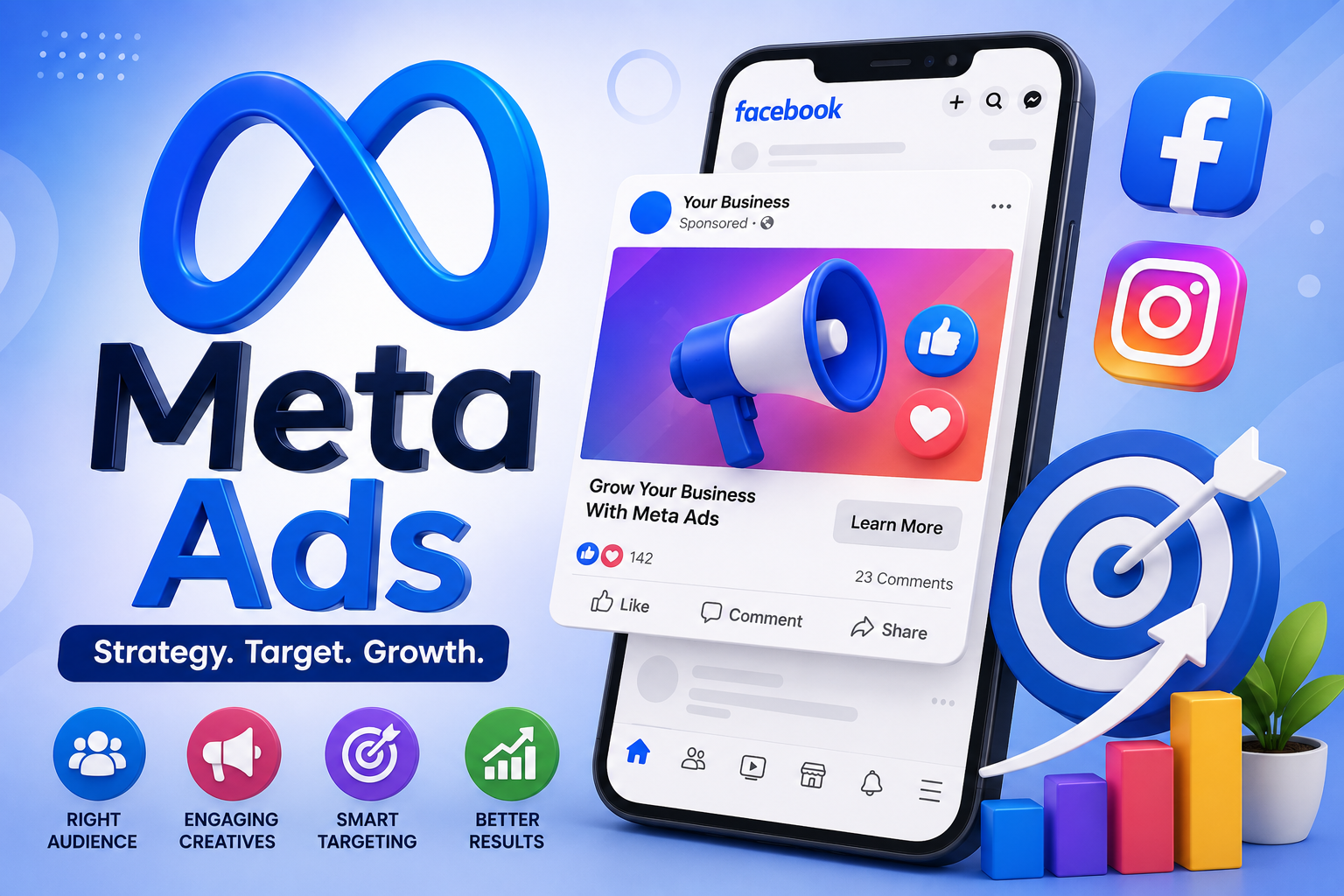
Meta Ads Strategies for Business Growth in 2026
Meta Ads has become an important part of digital marketing for businesses looking to reach potential customers across platforms such as Facebook and Instagram. With advanced audience targeting, engaging visual formats, retargeting capabilities and detailed campaign analytics, Meta advertising allows businesses to connect with users based on their interests, behavior and online activity.
In 2026, successful Meta Ads campaigns require more than simply boosting a post or creating a basic advertisement. Businesses need a strategic approach that combines audience targeting, creative content, campaign objectives, conversion tracking, retargeting and continuous optimization.
What Are Meta Ads?
Meta Ads are paid advertisements displayed across Meta's advertising ecosystem, including platforms such as Facebook and Instagram.
Businesses can use Meta Ads to promote:
- Products
- Services
- Websites
- Offers
- Events
- Apps
- Lead-generation campaigns
- Brand awareness campaigns
Depending on the campaign objective, advertisements can be designed to generate website visits, enquiries, leads, sales, messages, app activity or brand awareness.
For businesses, this provides an opportunity to reach potential customers while they are browsing social media.
Why Meta Ads Are Important for Businesses
Social media platforms provide businesses with a large audience, but organic reach alone may not always be enough to reach the right people.
Meta Ads allows businesses to create targeted campaigns based on different audience characteristics and campaign objectives.
A well-planned Meta Ads strategy can help businesses:
- Increase brand awareness
- Reach relevant audiences
- Generate quality leads
- Promote products and services
- Increase website traffic
- Generate enquiries
- Drive online sales
- Retarget interested users
- Build a stronger social media presence
The key is to focus on reaching the right audience with the right message at the right stage of the customer journey.
Facebook Ads and Instagram Ads
Facebook and Instagram are two major platforms within Meta's advertising ecosystem.
While both can be used for advertising, audience behavior and content formats can differ between the platforms.
Facebook Ads can be useful for businesses targeting broader audiences, local communities, interest-based audiences and users who actively engage with business pages and groups.
Instagram Ads are particularly useful for visually driven marketing, including:
- Reels
- Stories
- Image advertisements
- Carousel posts
- Product promotions
- Short-form videos
Businesses can use both platforms together to create a broader social advertising strategy.
1. Define Your Advertising Goal
Before creating a Meta Ads campaign, businesses should clearly understand what they want to achieve.
Common objectives include:
- Brand awareness
- Website traffic
- Lead generation
- Sales
- Engagement
- Messages
- App promotion
A campaign designed to generate leads should not be structured in exactly the same way as a campaign designed only to increase engagement.
Defining the objective helps determine the audience, creative format, campaign structure and measurement strategy.
2. Identify the Right Target Audience
Audience targeting is one of the major strengths of Meta advertising.
Businesses can create audiences based on different characteristics and signals.
Depending on the campaign, targeting can consider factors such as:
- Location
- Age
- Interests
- Online behavior
- Previous interactions
- Website activity
- Customer data
- Engagement with social media content
For a local business, geographic targeting can be especially important.
For example, a business operating in Pondicherry may want to focus its advertisements on potential customers in Pondicherry and nearby locations rather than advertising to an unnecessarily broad audience.
3. Create High-Quality Ad Creatives
The advertisement itself plays a major role in campaign performance.
Users scroll through large amounts of content every day, so businesses need creative advertisements that quickly communicate their value.
Effective Meta Ads can use:
- Short videos
- Reels
- Professional images
- Carousel advertisements
- Product demonstrations
- Customer testimonials
- Before-and-after visuals
- Educational content
- Promotional offers
The creative should clearly communicate what the business offers and why the audience should take action.
4. Use Strong Ad Copy
Visual content attracts attention, but the accompanying copy helps communicate the message.
Good Meta Ads copy should be:
- Clear
- Relevant
- Concise
- Benefit-focused
- Easy to understand
- Action-oriented
Instead of simply saying:
Digital Marketing Services
a stronger message could communicate:
Grow Your Business Online With Targeted Digital Marketing
followed by a clear call to action.
The message should match the audience and the campaign objective.
5. Use Video and Reels
Short-form video has become an important format for social media marketing.
Businesses can use videos to:
- Explain services
- Demonstrate products
- Share customer experiences
- Answer common questions
- Showcase behind-the-scenes content
- Present offers
- Build brand awareness
For businesses running Meta Ads, testing different video formats can help identify which creative styles attract the strongest engagement and conversions.
6. Build Retargeting Campaigns
Not every person who interacts with an advertisement will immediately become a customer.
Some users may:
- Visit the website
- View a product
- Watch a video
- Interact with an Instagram page
- Open a lead form
- Add an item to a cart
- Engage with previous advertisements
Retargeting allows businesses to reconnect with people who have already shown some level of interest.
This can be particularly useful because these users may already be familiar with the business.
7. Use Lookalike and Similar Audiences
Businesses that already have customer or engagement data can use audience-building strategies to reach people who may share characteristics with existing audiences.
For example, a business may have an audience consisting of previous customers or people who have interacted with its website.
Creating broader audiences based on valuable customer signals can help businesses discover potential new customers.
8. Optimize Landing Pages
A successful Meta Ads campaign does not end with the advertisement.
When someone clicks an advertisement, the landing page needs to provide a smooth experience.
A good landing page should have:
- Clear messaging
- Relevant information
- Fast loading speed
- Mobile-friendly design
- Strong call-to-action buttons
- Simple enquiry forms
- Trust signals
- Contact options
The landing page should also match the message presented in the advertisement.
For example, if an advertisement promotes Meta Ads services, the user should be directed to a relevant Meta Ads or digital marketing page rather than an unrelated homepage.
9. Track Conversions
Campaign performance should be measured based on meaningful business outcomes rather than simply impressions or clicks.
Businesses can track actions such as:
- Leads
- Sales
- Website enquiries
- Phone calls
- WhatsApp enquiries
- Form submissions
- Purchases
- Sign-ups
Conversion tracking helps businesses understand which campaigns and advertisements are contributing to actual business results.
10. Test Different Creatives
One advertisement may perform well while another similar advertisement may generate very different results.
Businesses should test different:
- Images
- Videos
- Headlines
- Ad copy
- Offers
- Calls to action
- Audience groups
- Landing pages
Continuous testing helps identify which combinations work best for a particular audience.
11. Control Advertising Costs
A successful Meta Ads strategy is not necessarily about spending the largest budget.
The goal is to use the available budget efficiently.
Businesses should regularly monitor:
- Cost per lead
- Cost per conversion
- Click-through rate
- Conversion rate
- Audience performance
- Creative performance
- Overall return on advertising spend
Campaigns that generate poor-quality traffic or expensive conversions can be reviewed and optimized.
12. Meta Ads for Local Businesses
Local businesses can use Meta Ads to reach audiences within specific geographic areas.
For example, a business in Pondicherry could promote its services to potential customers interested in its industry within the local market.
Local campaigns can be used for:
- Restaurants
- Educational institutions
- Real estate businesses
- Healthcare services
- Retail stores
- Professional services
- Local brands
- Digital marketing companies
Location-based advertising can help businesses focus their budget on audiences that are more relevant to their service area.
Meta Ads and Digital Marketing
Meta Ads should be part of a broader digital marketing strategy rather than being treated as an isolated advertising channel.
Businesses can combine Meta advertising with:
SEO + AEO + GEO + Google Ads + Content Marketing + Social Media Marketing + Website Optimization
For example:
SEO → Organic Traffic
Google Ads → Search Intent
Meta Ads → Social Audience
Content Marketing → Brand Authority
Website → Conversion
Together, these channels can create a stronger digital marketing ecosystem.
Meta Ads for Lead Generation
Lead generation is one of the most useful applications of Meta advertising for service-based businesses.
Businesses can use advertisements to encourage potential customers to:
- Submit an enquiry
- Request a quotation
- Contact the business
- Schedule a consultation
- Send a message
- Register for an offer
The quality of the lead should be more important than simply generating a large number of enquiries.
Businesses should therefore optimize campaigns toward customers who are genuinely interested in their products or services.
Meta Ads for Brand Awareness
Meta Ads can also help businesses introduce their brand to new audiences.
Brand awareness campaigns can showcase:
- Company values
- Products
- Services
- Customer experiences
- Brand stories
- Industry expertise
Repeated exposure to useful and relevant content can help businesses become more recognizable to their target audience.
Meta Ads for E-commerce Businesses
E-commerce businesses can use Meta advertising to promote products and drive users toward online purchases.
Product-focused campaigns can showcase:
- Product images
- Product videos
- Offers
- New launches
- Best-selling products
- Customer reviews
Retargeting can also be useful for reconnecting with users who have previously interacted with products or the website.
Benefits of Professional Meta Ads Management
Managing Meta Ads effectively requires continuous analysis and optimization.
Professional Meta Ads management can include:
- Audience research
- Campaign planning
- Creative strategy
- Ad copywriting
- Campaign setup
- Retargeting
- Budget optimization
- Conversion tracking
- Performance analysis
- A/B testing
- Landing-page recommendations
A structured approach can help businesses make better use of their advertising budget and improve campaign performance over time.
Meta Ads Strategies for Businesses in Pondicherry
For businesses targeting customers in Pondicherry, Meta Ads can be used to reach specific local audiences based on location, interests and business requirements.
Businesses can promote services such as:
- Digital marketing
- SEO
- Branding
- Website development
- Real estate
- Education
- Healthcare
- Retail
- Hospitality
- Local services
A well-targeted local campaign can help businesses increase awareness and generate relevant enquiries within their target market.
Conclusion
Meta Ads is a powerful digital advertising channel for businesses in 2026. With Facebook and Instagram advertising, businesses can reach relevant audiences, promote their products and services, generate leads and build brand awareness.
However, successful Meta advertising requires more than simply creating an advertisement. Businesses need to understand their target audience, create engaging creatives, use appropriate campaign objectives, optimize landing pages, track conversions and continuously test and improve their campaigns.