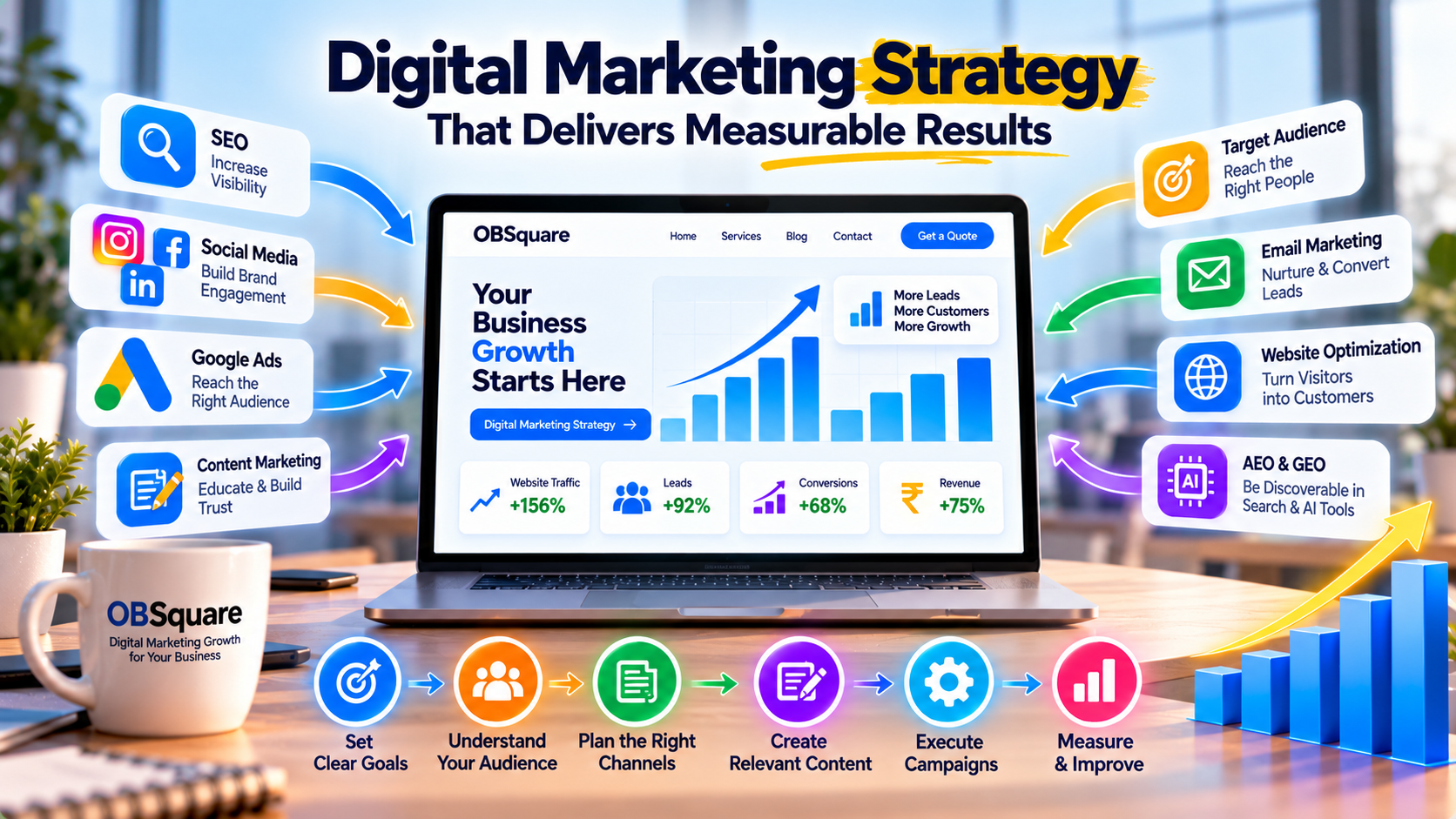
How Can Businesses Create a Digital Marketing Strategy That Delivers Measurable Results?
Introduction: Why Every Business Needs a Digital Marketing Strategy
Digital marketing has become an essential part of business growth. Customers use search engines, social media platforms, websites, online advertisements, and digital content to discover brands and evaluate their options before making purchasing decisions.
However, simply maintaining an online presence does not guarantee meaningful results. Businesses may publish content regularly, invest in advertisements, or develop a website without knowing whether these activities are reaching the right audience or generating enquiries.
A structured digital marketing strategy helps businesses connect their marketing activities with clear objectives. It provides a roadmap for understanding customers, selecting suitable channels, creating relevant content, allocating budgets, and measuring performance.
Whether a business is a startup, a local service provider, or an established company, a well-planned digital marketing strategy can help it use resources more effectively and make informed decisions.
1. Define Clear and Measurable Marketing Objectives
The first step in building an effective digital marketing strategy is deciding what the business wants to achieve.
Without clear objectives, marketing activities can become disconnected. A business may focus on increasing followers while its actual priority is generating qualified enquiries or increasing sales.
Common digital marketing objectives include:
- Increasing brand awareness among relevant audiences.
- Generating qualified leads and customer enquiries.
- Increasing website traffic from relevant sources.
- Improving conversion rates on important landing pages.
- Promoting specific products or services.
- Strengthening customer retention and repeat purchases.
- Increasing revenue from digital marketing activities.
Businesses should make these objectives measurable wherever possible.
For example, instead of setting a general goal such as “improve online marketing,” a business could aim to increase qualified website enquiries over the next three months.
The target should be realistic and based on the business's current performance, available budget, market conditions, and resources.
2. Understand Your Target Audience
A digital marketing strategy becomes more effective when businesses understand who they want to reach and what those customers need.
Target audience research helps identify the people most likely to benefit from a product or service. It also helps businesses develop relevant messaging, select appropriate platforms, and create content that addresses real customer concerns.
Consider the following questions:
- Who are your ideal customers?
- What problems are they trying to solve?
- What factors influence their purchasing decisions?
- Which digital platforms do they use?
- What questions do they ask before contacting a business?
- What concerns might prevent them from making a purchase?
- What makes your product or service relevant to them?
For example, a business offering professional digital marketing services to small companies may need to communicate affordability, practical business benefits, and campaign transparency.
A company targeting enterprise clients may need to emphasize strategic planning, reporting, integration, and scalability.
The more clearly a business understands its audience, the easier it becomes to create relevant campaigns rather than relying on generic marketing messages.
3. Analyse Your Current Digital Marketing Performance
Before launching new campaigns, businesses should evaluate their existing digital presence.
This assessment helps identify what is working, what needs improvement, and where marketing resources may be wasted.
Review the following areas:
Website performance: Check whether the website communicates the business's value clearly, works well on mobile devices, loads efficiently, and provides convenient ways to enquire.
Social media presence: Evaluate whether the content reaches the intended audience, communicates the brand consistently, and encourages meaningful engagement.
Search visibility: Review organic search performance, important landing pages, relevant search queries, and opportunities to improve website content.
Paid campaigns: Examine advertising expenditure, audience targeting, landing pages, conversion tracking, and the quality of leads generated.
Content marketing: Identify which articles, videos, and other content formats attract relevant audiences or support customer decisions.
Lead management: Check how enquiries are recorded, followed up, and converted into customers.
Tools such as Google Analytics, Google Search Console, advertising dashboards, and CRM systems can help businesses understand different parts of their digital marketing performance.
The findings should guide the next stage of planning rather than simply producing a list of statistics.
4. Choose the Right Digital Marketing Channels
Not every business needs to invest equally in every digital marketing channel. The right combination depends on the target audience, business objectives, budget, competition, and available resources.
Search Engine Optimization (SEO)
SEO helps businesses improve their visibility in unpaid search results by developing useful content, improving website structure, addressing technical issues, and meeting customer search intent.
It can support long-term discovery when customers search for relevant products, services, and information.
Social Media Marketing
Social media marketing helps businesses communicate with audiences, distribute content, showcase their work, and maintain brand awareness.
The choice of platform should reflect where the target audience spends time and how they prefer to consume information.
Google Ads and Paid Advertising
Paid advertising can help businesses reach relevant audiences through search and other advertising placements. Campaigns should have clear objectives, suitable targeting, relevant landing pages, and reliable conversion tracking.
Content Marketing
Content marketing uses helpful articles, guides, videos, graphics, and other resources to educate audiences and support customer decision-making.
Content should answer genuine customer questions and communicate the business's expertise accurately.
Email Marketing
Email marketing can help businesses nurture interested prospects, communicate useful updates, and maintain relationships with existing customers when messages are relevant and appropriately permission-based.
AEO and GEO
Answer Engine Optimization (AEO) focuses on making information clear and useful for answer-oriented search experiences. Generative Engine Optimization (GEO) focuses on improving how clearly and credibly brand information can be understood across AI-powered discovery experiences.
These approaches can complement SEO and content marketing, but businesses should not expect guaranteed placement in search results or AI-generated answers.
The best channel mix is the one that supports the business's objectives and can be managed and measured effectively.
5. Develop a Consistent Content Marketing Plan
Content plays an important role in helping potential customers understand a business, its services, and the value it offers.
A consistent content plan ensures that marketing messages remain relevant and that each piece of content serves a clear purpose.
Businesses can organize their content around several themes:
- Educational content: Explain industry concepts, common problems, and practical solutions.
- Service-focused content: Describe services, processes, benefits, and intended audiences.
- Brand-building content: Communicate company values, expertise, and business updates.
- Engagement content: Encourage relevant discussions and answer customer questions.
- Proof-based content: Share genuine testimonials, case studies, and documented results with appropriate permission.
A content calendar can help organize topics, formats, publishing dates, responsibilities, and campaign objectives.
For example, a business could publish an educational blog, create social media posts based on its main insights, and produce a short video answering one of the questions covered in the article.
Repurposing content thoughtfully helps businesses maintain consistency while adapting information to different platforms.
6. Create a Realistic Digital Marketing Budget
A digital marketing strategy should reflect the resources available to the business.
Without a clear budget, businesses may spread their investment across too many channels or spend money without understanding the expected outcomes.
Budget planning should consider:
- Content planning and production.
- Website improvements and maintenance.
- SEO and content optimization.
- Social media management.
- Paid advertising expenditure.
- Marketing tools and analytics.
- Creative design and video production.
- Campaign management and reporting.
Businesses should distinguish advertising spend from service fees, production costs, and software expenses.
For example, the amount paid to an advertising platform is different from the amount paid to a marketing agency for campaign planning and management.
Start with the channels most closely aligned with business objectives, establish a measurement process, and review the results before expanding the budget.
A realistic budget should also allow enough time and resources to improve campaigns rather than treating marketing as a one-time activity.
7. Optimize Your Website for Conversions
A digital marketing campaign may attract relevant visitors, but the website must help those visitors take the next step.
Conversion optimization focuses on reducing unnecessary friction and making it easier for users to understand an offer and contact the business.
Important improvements include:
- Clear headlines that explain the service or product.
- Simple navigation and logical page structure.
- Mobile-friendly layouts.
- Relevant and informative service pages.
- Visible calls to action.
- Easy-to-complete enquiry forms.
- Trust signals supported by genuine evidence.
- Consistent messaging between advertisements and landing pages.
For example, if a campaign promotes website development, the landing page should explain the available services, show relevant work where possible, and make it easy to request a consultation.
Businesses should measure form submissions, calls, bookings, or other meaningful actions rather than assuming that increased traffic automatically means increased sales.
8. Connect Marketing Activities With Lead Management
Generating enquiries is only one part of digital marketing. Businesses also need a reliable process for handling those enquiries and understanding which marketing activities produce suitable customers.
An effective lead management process can include:
- Recording enquiries from relevant marketing channels.
- Capturing essential information about the customer's needs.
- Identifying the original lead source where possible.
- Assigning responsibility for follow-up.
- Tracking the progress of each lead.
- Recording whether the enquiry becomes a customer.
- Reviewing the results to improve future campaigns.
A CRM system or structured lead management process can help businesses organize enquiries and reduce the risk of missing potential opportunities.
For example, if social media generates many enquiries but only a small percentage become customers, the business can investigate audience relevance, messaging, service fit, and follow-up quality.
This connects digital marketing performance with actual business outcomes.
9. Measure Results Using the Right KPIs
Key Performance Indicators (KPIs) help businesses evaluate whether marketing activities are progressing toward their objectives.
The appropriate metrics depend on the campaign and its intended outcome.
Marketing objectiveUseful metricsBrand awarenessReach, impressions, relevant audience growthWebsite discoveryOrganic clicks, relevant website visitsSocial media engagementShares, saves, meaningful interactionsLead generationQualified enquiries, cost per qualified leadConversion improvementLanding-page conversion rate, completed enquiriesCustomer acquisitionCustomer acquisition cost, lead-to-customer rateRevenue growthAttributed revenue, return on marketing investment
Businesses should avoid measuring every activity with the same metric. For example, an awareness campaign and a lead-generation campaign have different objectives and should be evaluated accordingly.
Review performance over consistent reporting periods and compare results with suitable baselines.
If a campaign underperforms, investigate possible causes such as audience targeting, content relevance, landing-page experience, offer clarity, or tracking errors before deciding what to change.
10. Use Data to Improve Your Digital Marketing Strategy
Digital marketing should be treated as an ongoing process of testing, learning, and improvement.
Performance data can help businesses identify which channels attract relevant audiences, which content addresses customer needs, and which landing pages generate enquiries.
A practical optimization process includes:
- Reviewing performance against the original objectives.
- Identifying the strongest and weakest activities.
- Investigating changes in audience behaviour.
- Testing specific improvements where appropriate.
- Recording the results of those changes.
- Adjusting budgets and priorities based on evidence.
For example, if a landing page receives relevant traffic but produces few enquiries, the business could test a clearer headline, a more relevant call to action, or a shorter form.
If a particular content topic attracts suitable visitors, the business could create related articles or videos that answer additional customer questions.
Changes should be based on evidence wherever possible. Businesses should also allow sufficient time and data for meaningful evaluation, particularly when results fluctuate.
11. Common Digital Marketing Strategy Mistakes to Avoid
Even businesses with good products and services can struggle when their marketing activities lack direction.
Common mistakes include:
- Setting goals that are too vague to measure.
- Trying to target everyone instead of a defined audience.
- Choosing marketing platforms without researching customer behaviour.
- Publishing content without a clear purpose.
- Investing in advertisements without conversion tracking.
- Ignoring website usability and mobile experience.
- Focusing on likes and followers instead of business objectives.
- Failing to follow up on generated enquiries.
- Changing strategies too frequently without sufficient data.
- Expecting every marketing channel to deliver immediate results.
Avoiding these mistakes helps businesses maintain a clearer direction and use their resources more effectively.
12. How OBSquare Can Help Businesses Build a Digital Marketing Strategy
OBSquare, a product of Seyfert Infotech, provides digital marketing services that can help businesses strengthen their online presence and coordinate their marketing activities.
Its services include SEO, AEO, GEO, blog writing, social media management, Google Business Profile management, Google Ads, Meta Ads, content creation, creative design, and website development.
These services can be coordinated around a business's objectives, target audience, and available resources.
For example, a business may improve its website and service pages, create educational content, distribute that content through social media, and use suitable advertising campaigns to reach relevant audiences.
Performance tracking can then help the business understand which activities contribute to meaningful enquiries and where further improvements are needed.
The goal is to create a practical marketing system in which each activity has a clear purpose and supports the broader business strategy.
Conclusion
A digital marketing strategy delivers greater value when business objectives, audience research, content, marketing channels, budgets, and performance measurement work together.
Rather than focusing only on publishing content or running advertisements, businesses should build a structured process that connects online visibility with customer engagement, qualified enquiries, and measurable outcomes.
Start by defining your objectives, understanding your audience, reviewing your existing digital presence, and choosing the channels that best support your goals. Track the results consistently and improve your strategy as new information becomes available.
With a clear plan and ongoing optimization, digital marketing can become a more focused and measurable part of business growth.
Ready to build a more effective digital marketing strategy? Explore OBSquare's digital marketing services to identify opportunities, coordinate your online presence, and develop a marketing approach aligned with your business goals.